Before you buy.
Does the person answering need an account or a password?
No. The e-mail has one button. It opens a page with that week's question and a text box, and the link itself is the key. There is nothing to install, nothing to remember and no app of ours.
That also means the link is worth keeping private, the same way an e-mail is. Anyone who has the link can read and add to that one answer. It opens one question, never the whole book.
What if they do not answer a question?
Nothing happens. The next question arrives the following week as usual, and the old link keeps working, so they can go back to it whenever they like. We never send a reminder and never ask again.
Every question also carries a short line offering an easier way past it, because some of them can land on a bad week. A question that can touch a death or a quarrel says plainly that leaving it changes nothing.
What are the questions actually like?
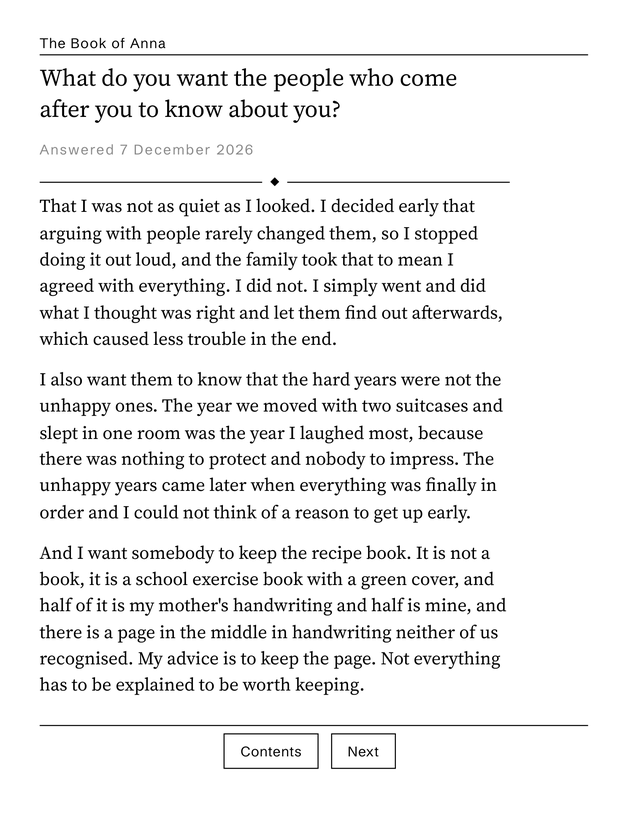
Specific and sensory, one sentence each. What the kitchen smelled like on a Sunday morning when you were ten. Who taught you to ride a bike and where you fell. What was the first thing you bought with your own money. What is the right way to sharpen the tool you use most.
There are 260 of them in a fixed order, which is five years of weeks, grouped in ten arcs: childhood and home, food, school, places, work, the things you made and mended, love and family, the country changing around you, faith and feasts, and what you want remembered. None of them assumes a country, a religion, a marriage, a living spouse or children.
Who can read the answers?
The person who wrote them, the person who gave the subscription, and the owner of ARLing when something needs fixing. Nobody else. They are never sold, never shared and never used to train anything, and one line to andrej@arling.sk exports or deletes all of it. The whole of it is written out in section 04 above.
What if your server disappears?
Every answer is e-mailed back to the person who wrote it the moment they press Save. Their words are in their own inbox as well as on our server. If ARLing stopped existing tomorrow, the memories would still be theirs.
When does the book arrive, and in what form?
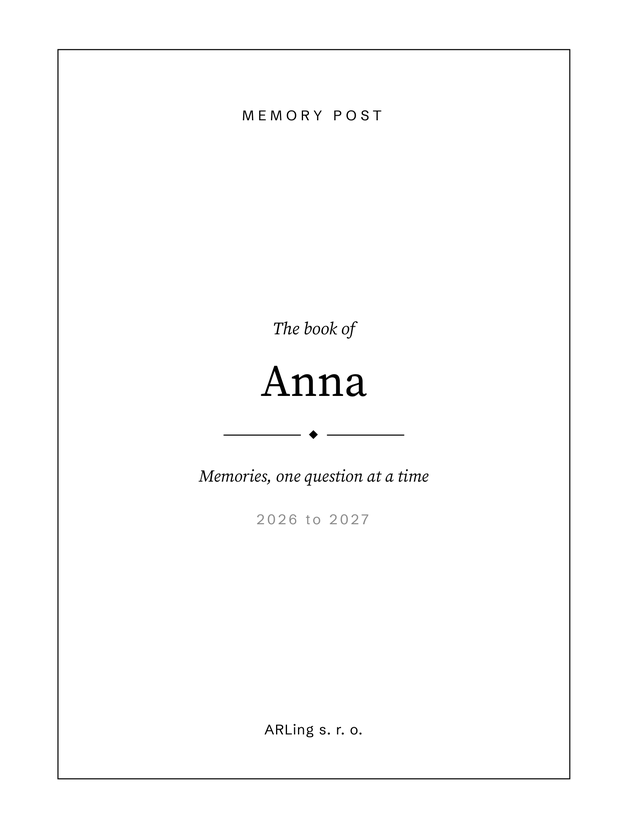
At the end of every month, and again at the end of the year. Both of you get a link to the same three files: an e-ink PDF at 157 x 210 mm, an A4 PDF and a US Letter PDF. The A4 and Letter files print at one hundred percent.
Being honest about the limit of that claim: the page sizes, the links and the form fields are measured in the finished PDF by our own check, but we have not tested a book on a physical reMarkable, Kindle Scribe or Boox. Nobody here owns one.
Which languages can it be in?
English, Slovak, Czech, German or Polish. You choose when you set the gift up, and the choice applies to the weekly e-mail, the answering page and the typeset book.
Plainly: the English and Slovak questions were written by us. The Czech, German and Polish ones were translated with AI assistance and have not yet been read by a native speaker. If you take one of those three and something reads badly, write to andrej@arling.sk and we will fix the wording.
Can I cancel, and can I get my money back?
You can cancel at any time in the Stripe customer portal, with the e-mail address you paid with. The subscription stays active to the end of the period you already paid for, and every answer written and every book already made stay yours.
On refunds, the law: digital content delivered immediately with your consent carries no right of withdrawal, which in Slovakia is section 19 paragraph 1 letter m) of Act No. 108/2024 Coll. and across the EU Article 16 letter m) of Directive 2011/83/EU. That said, if the first question never arrived, or a file is broken, write to andrej@arling.sk and we will fix it or send the money back. That is a different thing from changing your mind.
Is this the same as a blank memory journal?
No, and that is the whole point. A blank journal asks somebody to sit down and write about their life, which almost nobody does. Memory Post asks one small question a week and does the sitting down for them, then does the typesetting. What you end up with is not a book of prompts, it is a book of their answers.