Musical instruments word search, free printable with pictures
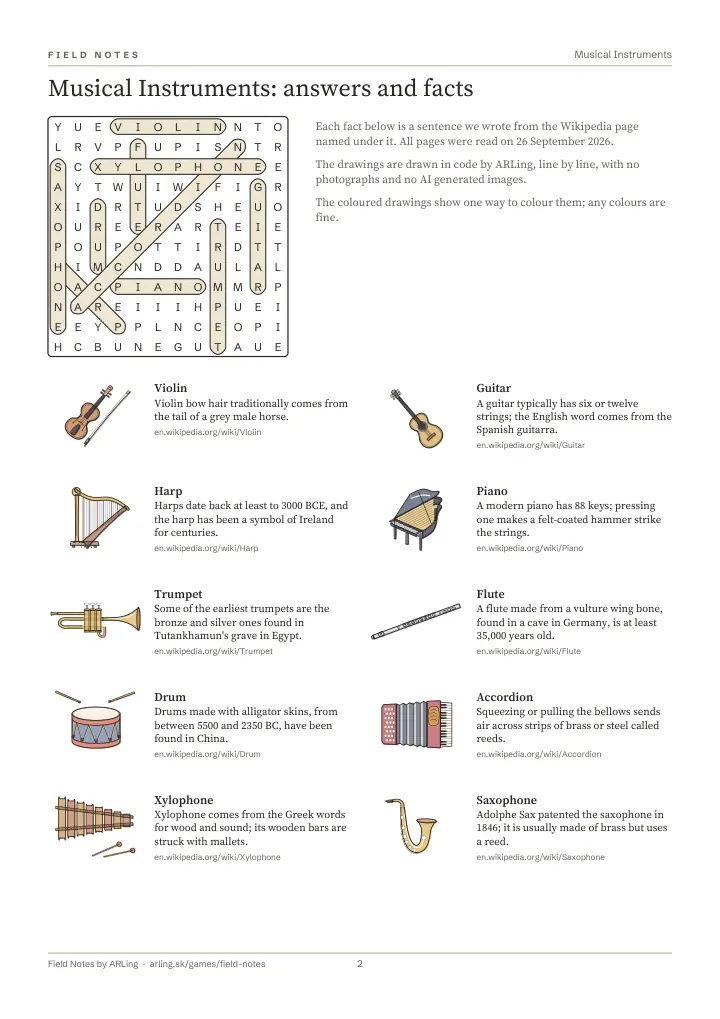
Strings, keys, brass, reeds and drums: ten instruments hidden in a 12 by 12 grid, with a drawing of each to colour. Page two has the answers and one short fact for every instrument, with the page it comes from.
Two pages in each file: A4 82 kB, US Letter 82 kB. Free, with no account and no email address.
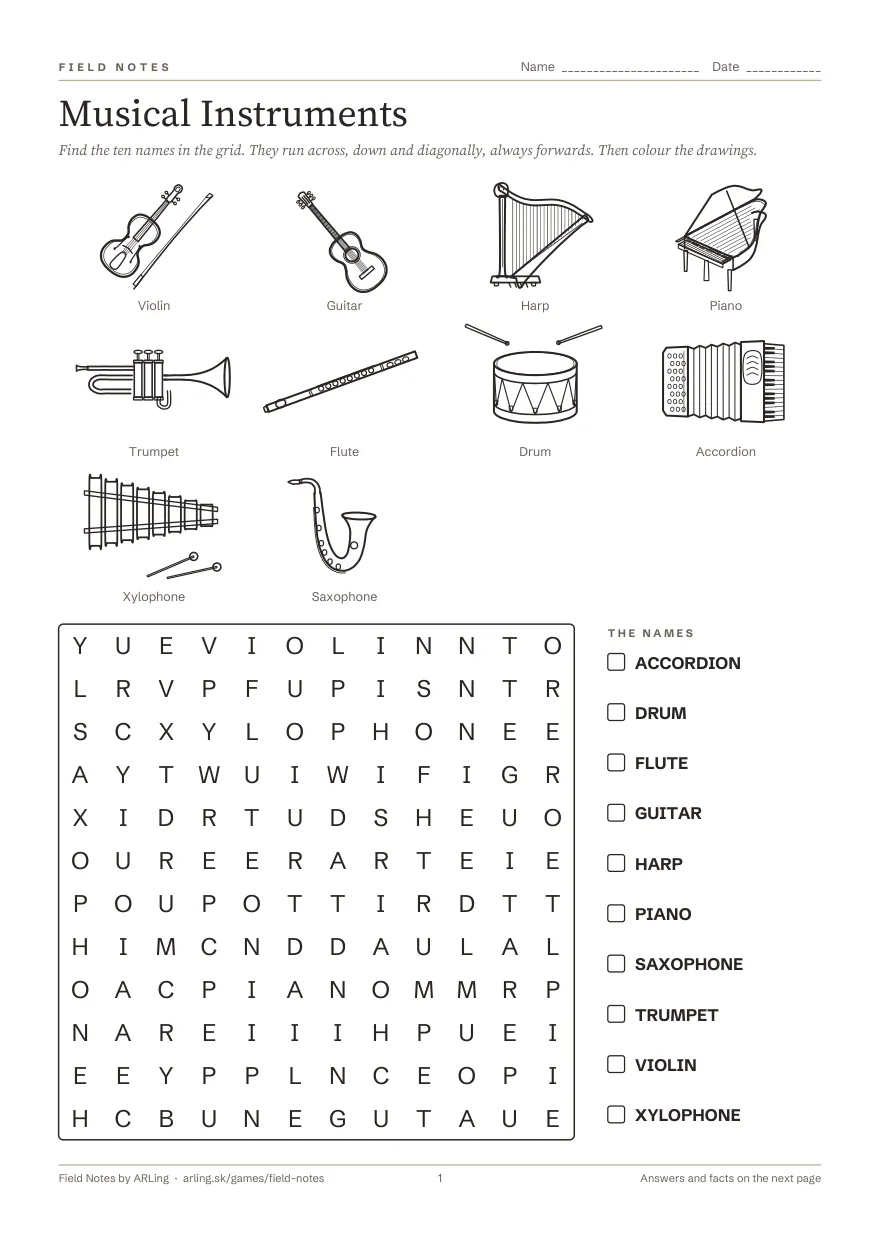
The words
The ten musical instruments in the grid, with a fact for each.
VIOLIN
Violin bow hair traditionally comes from the tail of a grey male horse.
GUITAR
A guitar typically has six or twelve strings; the English word comes from the Spanish guitarra.
HARP
Harps date back at least to 3000 BCE, and the harp has been a symbol of Ireland for centuries.
PIANO
A modern piano has 88 keys; pressing one makes a felt-coated hammer strike the strings.
TRUMPET
Some of the earliest trumpets are the bronze and silver ones found in Tutankhamun's grave in Egypt.
FLUTE
A flute made from a vulture wing bone, found in a cave in Germany, is at least 35,000 years old.
DRUM
Drums made with alligator skins, from between 5500 and 2350 BC, have been found in China.
ACCORDION
Squeezing or pulling the bellows sends air across strips of brass or steel called reeds.
XYLOPHONE
Xylophone comes from the Greek words for wood and sound; its wooden bars are struck with mallets.
SAXOPHONE
Adolphe Sax patented the saxophone in 1846; it is usually made of brass but uses a reed.
For teachers and parents
What is on the sheet, and how to use it.
- Grid
- 12 by 12 letters
- Names
- Ten to find, 4 to 9 letters long
- Directions
- across, down and diagonally, always forwards
- Pages
- the puzzle, then the answers with ten facts
- Paper
- A4 or US Letter; page 1 is line art and needs no colour printer
Who it suits. Our suggestion is children who already read short words on their own, roughly ages 7 to 11. Younger children can colour the drawings while an adult reads the names aloud. This is our suggestion, not a tested reading level.
How long it takes. We have not timed it with a class. The grid on its own is a short activity; the colouring and the facts on page 2 can stretch it to fill a lesson.
In class or at home
- Print page 1 for each child, and page 2 once, for yourself or to share at the end.
- Read the names aloud and look at the drawings together before starting.
- Each child ticks a name in the list when it is found, then colours the drawings.
- Finish with page 2: read a fact or two aloud. Each fact names its Wikipedia page, so older children can look it up and read more.
Questions
Questions about this word search.
Is this musical instruments word search free to print?
Yes. Both PDF files, A4 and US Letter, are free to download and print, with no account and no email address.
Where are the answers?
On page 2 of the same PDF: the grid with every name circled, the drawings in colour, and one short fact for each instrument with the Wikipedia page it comes from. Print only page 1 if you want to keep the answers for later.
Which way do the words go?
Across, down and diagonally, always forwards, never backwards. Each of the ten names is in the grid exactly once; our program checks that before the file is made, and also checks that no rude word turns up among the filler letters.
Should I print A4 or US Letter?
Pick the paper in your printer: US Letter in the United States and Canada, A4 in most other countries. In the print dialog choose actual size or 100%.
More printables
Eight more word searches with pictures.
 Ocean animals word search
 Solar system word search
 Vegetables word search
 Birds word search
 Trees word search
 Mountains word search
 Inventions word search
 Minerals and gems word search
All nine on one page: free printable word searches. Or play Field Notes online, with the same drawings and facts in the browser and a new page every day.